

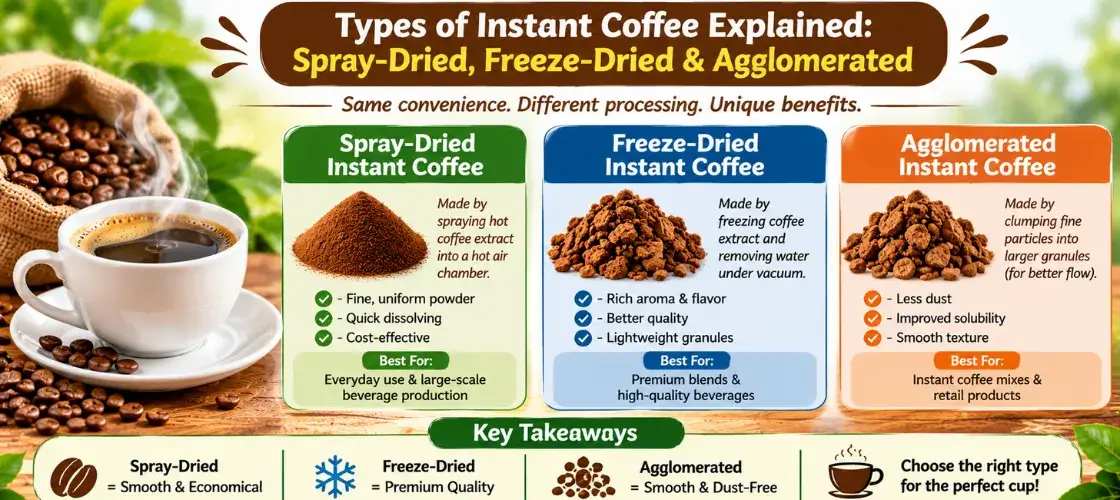
Instant coffee looks simple in the jar, but how it’s dried shapes how it pours, dissolves, and tastes. The three main types of instant coffee are spray-dried, freeze-dried, and agglomerated, and all three start from the same brewed extract. A coffee manufacturer uses different drying processes to remove the water, influencing the coffee’s texture, solubility, aroma, and flavour.
How Instant Coffee Is Made: From Roasted Bean to Soluble Powder
All types of instant coffee share the same first steps before drying sets them apart.
- Roasting and grinding: Arabica or Robusta beans are roasted, then ground for even extraction.
- Extraction: Hot water passes through columns under pressure, drawing out soluble solids.
- Aroma recovery: Many producers capture volatile aromas and return them before drying.
- Concentration: Evaporation or freeze concentration raises the solids content.
- Drying: The concentrate is spray-dried, freeze-dried, or spray-dried and then agglomerated.
- Packing: The coffee goes into moisture-proof packaging.
Step five is where the three formats part ways.
Spray-Dried Instant Coffee: Fine, Fast-Dissolving Powder
Spray drying sprays concentrated extract as a mist into hot air, often 200 to 300°C (390 to 570°F) at the inlet, drying it in seconds.
- Appearance: Fine, uniform, light to medium brown powder
- Solubility: Disperses quickly and blends evenly with dry ingredients
- Flavor: Bold and roast-forward
- Cost: Economical, with high throughput
It is the practical choice for volume production.
Freeze-Dried Instant Coffee: Aroma-Rich Granules
Freeze drying freezes the concentrate to around -40°C (-40°F), breaks it into granules, and removes the ice by sublimation under vacuum.
- Appearance: Irregular, glassy, dark brown granules
- Aroma: Retains more volatile compounds thanks to low temperatures
- Flavor: Smooth, rounded, and close to brewed coffee
- Cost: Higher, due to longer drying cycles
It suits products where aroma leads.
Agglomerated Instant Coffee: Free-Flowing Granules That Dissolve Easily
Agglomerated instant coffee begins as spray-dried powder that is moistened with steam so particles cling into clusters, then dried again.
- Appearance: Uniform, porous granules
- Solubility: Water enters the pores quickly, so granules dissolve smoothly
- Handling: Free-flowing and low in dust
- Cost: Between spray-dried and freeze-dried
It offers a granular look with spray-dried economics.
Spray Dried vs Freeze Dried Coffee: Which Process Delivers What?
The spray-dried vs freeze-dried coffee choice comes down to heat, aroma, and budget.
- Drying conditions: Hot air for seconds versus freezing and vacuum over several hours.
- Form: Fine powder versus irregular granules.
- Aroma retention: Moderate versus high.
- Flavor: Bold and roast-led versus smooth and close to brewed.
- Cost: Lower versus premium.
Agglomerated coffee bridges the two, pairing spray-dried cost with a granular format. Starlon Naturals produces all three formats, which makes side-by-side sampling simple.
Types of Instant Coffee: Which One Is Used for What?
Each type of instant coffee suits a different product.
Best Uses of Spray-Dried Coffee
Volume products lean on this format.
- 3-in-1 and 2-in-1 premixes
- Vending machines
- Ready-to-drink beverages
- Bakery and dessert flavoring
Each benefits from fast blending and low cost.
Best Uses of Freeze-Dried Coffee
Premium products favor these granules.
- Premium retail jars and sachets
- Specialty instant ranges
- Hotel and airline service
- Iced coffee drinks
Here, aroma justifies the higher price.
Best Uses of Agglomerated Coffee
Mid-range products suit this format.
- Mid-range retail jars
- Office coffee stations
- Private label brands
It delivers a premium look at a moderate price.
How to Choose the Right Type of Instant Coffee
Check these points before you place an order.
- Solubility needs: Powder suits dry mixes, while granules suit cup-by-cup use.
- Aroma and budget: Freeze-dried leads on aroma, spray-dried on cost.
- End product: Premixes lean spray-dried, while premium retail leans freeze-dried.
- Hot or cold use: Test samples in cold water and milk for iced drinks.
- Order volume: Confirm minimum order quantities early.
- Customization: Specify blend, particle size, and caffeine level. Share these in your product brief when you request samples.
Settling these points early speeds up sampling and approval.
Spray-Dried, Agglomerated & Freeze-Dried Instant Coffee Supply
Starlon Naturals is a Black Tea supplier in India, offering bulk black tea solutions for businesses, brands, and international buyers. The company sources quality tea and provides consistent blends to meet diverse customer requirements. With a focus on quality, reliability, and bulk supply, Starlon Naturals serves customers across Europe, the USA, the Middle East, Africa, and Asia. Explore the black tea range.
Conclusion
Spray-dried, freeze-dried, and agglomerated coffee all begin as the same extract, and drying decides cost, texture, and aroma. Knowing the types of instant coffee helps you match format to product. Request samples of each and run a side-by-side cup test with your own recipe.
Frequently Asked Questions
1. What is agglomerated instant coffee and how is it made?
Agglomerated instant coffee is spray-dried powder moistened with steam, clustered into porous granules, and dried again.
2. Why is freeze-dried instant coffee more expensive than spray-dried coffee?
Freeze drying runs for hours under cold and vacuum, using more energy than seconds-long spray drying.
3. Does the drying method change the taste of instant coffee?
Yes. Freeze-dried coffee keeps more aroma and tastes closer to brewed coffee, while spray-dried coffee tastes bolder.
4. Which type of instant coffee dissolves most easily in water and milk?
Agglomerated and freeze-dried granules dissolve more easily thanks to their porous structure.
5. Is instant coffee made from real coffee beans?
Yes. EU rules require dried coffee extract to contain at least 95% coffee-based dry matter.
6. Which type of instant coffee is best for 3-in-1 premixes and RTD drinks?
Spray-dried coffee is the usual choice, as its fine powder blends evenly with creamer and sugar.
7. Can Arabica and Robusta beans be used for every type of instant coffee?
Yes. Robusta adds body and soluble yield, while Arabica brings softer acidity and aroma.
8. What is the shelf life of instant coffee?
Sealed instant coffee typically keeps for 18 to 24 months in a cool, dry place.
