One spoon of powder, a splash of cold water, and seconds later, you have tea. No kettle, no steeping. That everyday magic is tea extract at work, and instant tea is simply tea extract in disguise. The same ingredient powers bottled iced teas, energy drinks, supplements, and baked goods. The tea extract manufacturing process follows a precise journey, starting with the right leaves and ending at the spray dryer.
What Is Tea Extract?
Tea extract is tea in concentrated form. Instead of steeping cup by cup, manufacturers brew tea at scale, separate the liquid from the spent leaves, concentrate it, and dry it. What’s left is a powder (or sometimes a liquid) packed with the polyphenols, amino acids, caffeine, and aroma that give tea its personality. As a Darjeeling Tea Extracts supplier, manufacturers provide concentrated tea ingredients that retain the distinctive character and flavour of Darjeeling tea. A small spoonful carries the strength of several cups, making it an ingredient to build with, not a finished drink.
Tea Extract Manufacturing Process: Step-by-Step
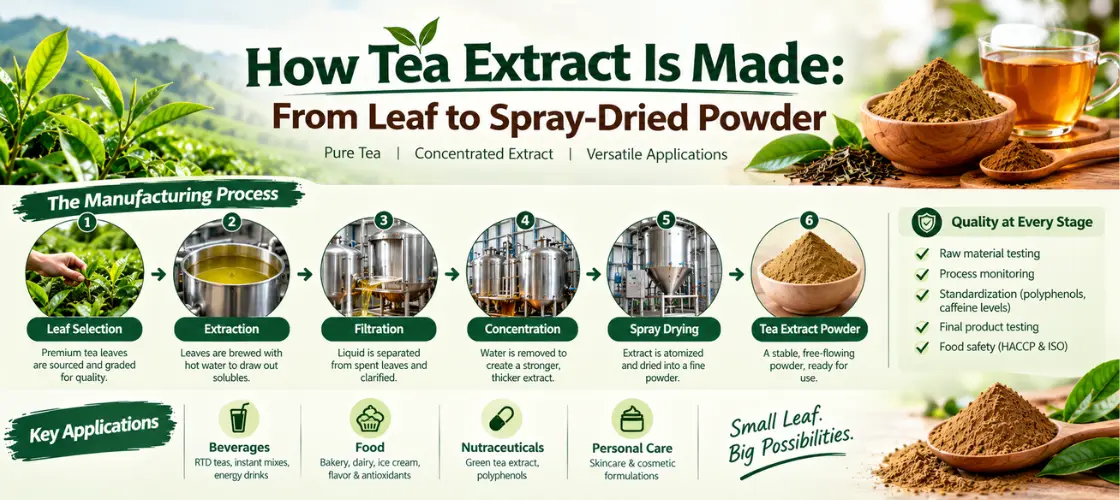
The tea extract manufacturing process follows a clear sequence, each stage setting up the next.
- Extraction: Leaves meet hot water, which draws out the solubles: polyphenols, amino acids, caffeine, and aroma. Time and temperature are controlled to protect flavour.
- Filtration: The liquid is separated from spent leaves and fine particles, then clarified.
- Concentration: Evaporation or membrane filtration reduces it to a thicker, stronger liquid by removing water before drying.
- Standardization: The concentrate is adjusted so every batch hits consistent polyphenol or caffeine levels.
The concentrate is now ready for drying, where it becomes a stable powder for storage and further use.
How Tea Extract Is Made Into Spray-Dried Powder
Spray drying turns the liquid into powder, and it happens fast:
- Atomizing: The concentrate is pumped into a hot chamber and sprayed through a nozzle into a fine mist.
- Flash drying: As the droplets hit hot air, the water flashes off in seconds, leaving dry particles.
- Collecting: The particles settle out as a fine, uniform powder, ready to pack.
- Protecting flavor: Each droplet dries almost instantly, so the extract sees little heat, protecting flavor, color, and active compounds.
The result is a free-flowing powder that dissolves fast and ships without the dead weight of water.
Tea Extract Production Process: Quality Checks at Every Stage
Quality in the tea extract production process isn’t a final step. It runs through the whole line:
- Incoming leaves: Screened for grade, moisture, and contaminants before brewing.
- In process: Operators track temperature, solids, and pH to keep each batch on spec.
- Finished powder: Tested for moisture, particle size, solubility, polyphenol or caffeine levels, and microbial safety.
- Traceability: Batch records tie a powder back to the leaves it came from.
Serious manufacturers run this under food-safety systems like HACCP and ISO, which keep one batch performing like the next.
Common Applications of Spray-Dried Tea Extract
Spray-dried tea extract turns up in more places than you’d guess:
- Beverages: Ready-to-drink iced teas, instant mixes, energy drinks, and flavored waters.
- Food: Bakery, dairy, and ice cream, for tea flavor and a hit of antioxidants.
- Nutraceuticals: Supplements that lean on green tea extract for its polyphenols.
- Personal care: Cosmetic and skincare formulas that want tea’s active compounds.
Its solubility and long shelf life suit a wide range of recipes.
How to Choose a Tea Extract Supplier?
Not every supplier delivers the same consistency, so check a few things before you commit:
- Certifications: Food-safety systems like ISO and HACCP, plus export approvals, signal real process control.
- Consistency: Ask about standardization and whether they can hold a spec batch after batch.
- Range: Multiple tea types and custom blends give you room to grow.
- Support: Clear documentation, samples, and quick communication save headaches at scale.
Get these right, and your supplier becomes a partner, not a bottleneck.
Starlon Naturals: Tea Extract Manufacturing and Supply
Starlon Naturals manufactures and supplies spray-dried tea extracts for use in food, beverage, and nutraceutical applications. Working with Camellia sinensis across green, black, and other tea types, it handles the full path from leaf to powder: extraction, concentration, spray drying, and testing. As a Speciality Tea Extracts exporter, Starlon Naturals offers products that can be standardized to target compounds and tailored to specific applications, with options for custom blends. For brands that want a consistent, traceable extract without running the process in-house, this approach removes a lot of complexity.
Conclusion
From fresh leaf to fast-dissolving powder, tea extract comes from careful extraction, concentration, and spray drying, backed by quality checks at every turn. That care is why a good extract tastes clean, dissolves easily, and delivers the same cup after cup, whether in canned iced tea or a wellness supplement.
Frequently Asked Questions
How is tea extract made step by step?
Leaves are extracted in hot water, filtered, concentrated, standardized, and spray-dried into powder.
What is the difference between liquid tea extract and spray-dried tea powder?
Liquid extract is concentrated tea in liquid form; the powder has the water removed, so it stores longer and dissolves on demand.
Why is spray drying used in tea extract production?
Spray drying removes water in seconds with minimal heat, protecting flavor and active compounds while creating a shelf-stable powder.
Does tea extract retain the flavor and aroma of brewed tea?
Mostly yes, though some volatile notes soften during processing. Low-exposure drying preserves much of the character.
Is tea extract soluble in cold water?
Yes, in both hot and cold water, which suits iced teas and instant mixes.
What is the shelf life of spray-dried tea extract powder?
Stored cool, dry, and sealed, it keeps for 18 to 24 months. Follow the supplier’s stated shelf life.
Can tea extract be customized for beverage and food applications?
Yes. It can be standardized to target compounds and adjusted for specific drinks, foods, and supplements.
