

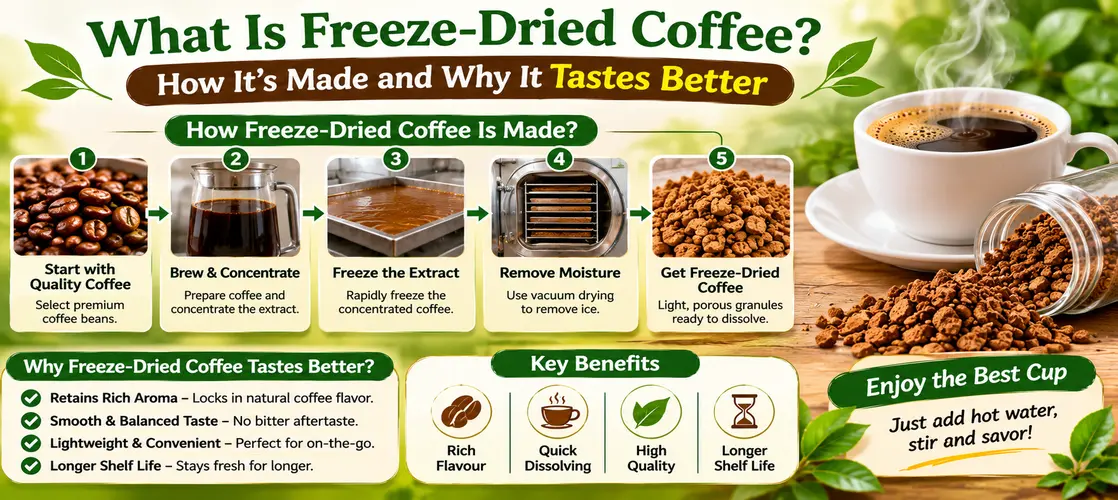
Open a jar of premium instant coffee, and you will often see dark, glassy granules in place of a fine powder. It is brewed coffee extract that is frozen and then dried under vacuum, so the water leaves as vapor with minimal heat. That cold process keeps more aroma compounds, which is why the scent feels richer the moment the lid opens.
Freeze-Dried Coffee Process: Freezing, Vacuum, and Sublimation Step by Step
The freeze-dried coffee process runs in three phases: freezing, vacuum, and sublimation. Here is how each step works.
- Brewing: Roasted, ground coffee is extracted with hot water in industrial columns.
- Concentrating: The extract is concentrated, often by freeze concentration at low temperature.
- Foaming: Many producers whip gas into the concentrate to fine-tune granule density and color.
- Freezing: The concentrate is chilled into a slush, then frozen into slabs at around -40°C (-40°F).
- Grinding: The frozen slabs are broken and sieved into uniform granules.
- Vacuum: The granules go onto trays in a vacuum chamber, and the pressure drops far below atmospheric levels.
- Sublimation: Gentle heat turns the ice straight into vapor, which condenses on chilled coils.
- Packing: The dry granules are packed in airtight jars or pouches, often flushed with nitrogen.
The result is a dry, porous granule that still carries much of the original extract’s aroma.
Freeze-Dried Instant Coffee: Granule Look, Texture, and Solubility
Freeze-dried instant coffee stands apart on the shelf, and its structure shapes how it looks, pours, and dissolves.
- Shape: Irregular, angular granules a few millimeters across
- Color: Deep, glossy brown, often darker than spray-dried powder
- Texture: Crisp and porous, as sublimating ice leaves tiny channels behind
- Solubility: Water enters the pores quickly, so the granules dissolve readily
- Moisture: Very low, supporting a long shelf life in sealed packaging
Together, these traits give a clean, low-dust pour and a premium look in the jar.
Why Freeze Dried Coffee Tastes Better: Aroma and Flavor Retention
Part of understanding freeze-dried coffee is understanding its flavor. Effective coffee sourcing in India plays an important role in selecting quality beans with the right flavour and aroma profiles. Researchers have identified more than 800 volatile compounds in roasted coffee, and many evaporate easily with heat. Freeze drying keeps temperatures low, helping preserve more of these aromatic compounds in the granules.
- Low-temperature drying: The coffee stays frozen through the main drying stage.
- Aroma retention: Granules hold more volatile compounds than hot-air dried powder.
- Flavor balance: The cup tastes smooth and rounded, with softer bitterness.
- Bean character: Delicate Arabica notes come through, which suits specialty blends.
- Aroma on opening: Nitrogen-flushed packs hold aroma until first use.
Taste stays personal, yet for aroma-led products, freeze-drying is the method of choice.
Uses of Freeze-Dried Coffee: Where the Granules Add Value
Knowing what freeze-dried coffee is makes its uses easy to map:
- Premium retail jars and sachets
- Specialty and single-origin instant ranges
- Hotels, airlines, and hospitality service
- Iced coffee and quick café drinks
In each case, aroma and appearance help justify the premium price.
Freeze-Dried vs. Spray-Dried Coffee: Which One Should You Choose?
Both formats begin with the same extract, yet the drying method shapes the result.
- Process: Freeze drying works under vacuum over several hours. Spray drying uses hot air for seconds.
- Form: Granules versus fine powder.
- Aroma: Higher retention versus moderate retention.
- Taste: Smooth and rounded versus bold and roast-forward.
- Cost: Premium versus economical.
- Typical fit: Premium retail and hospitality versus premixes and vending.
Suppliers such as Starlon Naturals produce both formats, which makes side-by-side sampling straightforward.
Starlon Naturals: Freeze Dried Instant Coffee Supplier and Exporter in India
Starlon Naturals is a freeze-dried instant coffee supplier and exporter in India, serving beverage brands, retailers, cafés, and food service businesses. As a Premixes exporter in India, the company also supports bulk supply requirements with custom formulations and private label solutions. It sources Arabica and Robusta beans and offers custom blends, private label packaging, and spray-dried and agglomerated formats. Production is backed by ISO 22000, HACCP, GMP, HALAL, and KOSHER certifications, with exports to Europe, the USA, the Middle East, Africa, and Asia. Explore the freeze-dried instant coffee range.
Conclusion
Freeze drying trades speed for aroma, keeping more of the compounds that give coffee its character. Now that you know what freeze-dried coffee is and how it compares with spray-dried powder, run a blind cup test of both with your audience and let the results shape your specification.
Frequently Asked Questions
1. What does freeze-dried coffee taste like?
It tastes smooth and rounded, with a fuller aroma than spray-dried coffee and a profile close to brewed coffee.
2. Is freeze-dried coffee better than fresh brewed coffee?
Freshly brewed coffee offers a fuller aromatic range. Freeze-dried coffee delivers a close match in seconds.
3. Why does freeze-dried coffee look like irregular granules?
The frozen slab is broken and sieved before drying, so each granule keeps its fractured, angular shape.
4. Can freeze-dried coffee be used for iced coffee and cold brew?
Yes. The porous granules dissolve in cold water and milk with a little extra stirring.
5. Is freeze-dried coffee the same as dehydrated coffee?
Freeze drying is one form of dehydration. It removes water by sublimation at low temperatures in place of heat.
6. Can freeze-dried coffee be made at home?
Home freeze dryers can dry brewed coffee, though commercial granules rely on industrial extraction and vacuum control.
7. What is sublimation in the freeze-drying process?
Sublimation is ice turning straight into vapor. In freeze-dried coffee, low pressure makes this possible.
8. How long does the freeze drying process take?
Industrial freeze drying typically runs for several hours per batch, compared with seconds for spray drying.
