

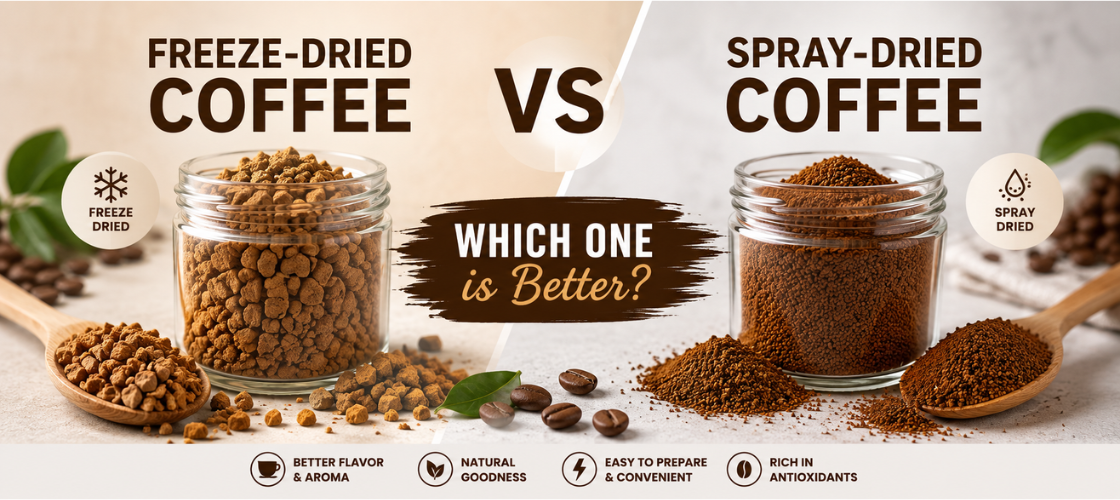
Instant coffee has evolved over the years, with manufacturers adopting advanced processing technologies to preserve flavor, aroma, and functionality. Among the most widely used coffee drying methods are spray drying and freeze drying. Both techniques transform brewed coffee extract into a stable, shelf-ready product, but they differ considerably in production processes, product quality, cost, and commercial applications. Understanding the differences between freeze-dried vs. spray-dried coffee can help beverage brands, distributors, private-label manufacturers, and consumers determine which option best meets their needs.
Introduction to Coffee Drying Methods
Coffee drying methods play a critical role in instant coffee production. After a coffee manufacturer roasts, grinds, and brews the beans into a concentrated extract, the water must be removed to create a dry product with a long shelf life. The two dominant methods used globally are spray drying and freeze drying.
Spray drying focuses on efficiency and large-scale production, making it popular for mass-market instant coffee. Freeze drying prioritizes flavor and aroma retention, making it the preferred choice for premium instant coffee products. Both methods have distinct advantages depending on quality expectations, production goals, and market positioning.
Key Differences Between Spray-Dried and Freeze-Dried Coffee
Understanding the freeze-dried vs. spray-dried coffee differences can help brands choose the right format based on flavor retention, production efficiency, and target market needs.
| Feature | Spray-Dried Coffee | Freeze-Dried Coffee |
|---|---|---|
| Drying Method | Hot air rapidly evaporates water from the coffee extract | Frozen coffee extract is dehydrated through sublimation |
| Processing Temperature | High temperatures | Low temperatures |
| Production Speed | Faster | Slower |
| Manufacturing Cost | Lower | Higher |
| Flavor Retention | Moderate | Excellent |
| Aroma Preservation | Moderate | Superior |
| Appearance | Fine powder | Larger granules or crystals |
| Solubility | Very good | Excellent |
| Shelf Life | Long | Long |
| Premium Positioning | Standard and commercial products | Premium and specialty products |
| Bulk Production Suitability | Highly suitable | More specialized |
| Common Applications | Instant coffee sachets, vending mixes, premixes | Premium instant coffee, specialty beverages |
In comparing freeze-dried vs. spray-dried coffee, neither method is universally better. The choice depends on whether cost efficiency or sensory quality is the primary objective. Spray drying offers scalability and affordability, while freeze drying delivers a product that more closely resembles freshly brewed coffee.
Spray Drying Process
Spray-drying coffee is one of the most widely used methods in commercial instant coffee manufacturing due to its speed and cost-effectiveness.
How Spray Drying Works
In the spray-dried coffee process, concentrated coffee extract is atomized into tiny droplets and sprayed into a chamber filled with hot air. The moisture evaporates almost instantly, leaving behind fine coffee particles that are collected and packaged. The process enables high-volume production while maintaining product stability and solubility.
Characteristics of Spray-Dried Coffee
Pros
- Cost-effective production method
- Suitable for large-scale manufacturing
- Excellent solubility in hot water
- Consistent product quality
- Efficient for bulk export markets
Cons
- Higher temperatures may reduce some volatile aroma compounds
- Flavor complexity may be lower than that of freeze-dried coffee
- Powder format can be more susceptible to dust generation during processing
Spray-dried coffee characteristics typically include:
- Fine powder texture
- Uniform appearance
- Fast dissolution
- Economical pricing
- Suitable for coffee premixes and vending applications
Because of its affordability and scalability, spray-dried coffee remains a preferred choice for mass-market instant coffee and for a coffee premix manufacturer producing 3-in-1 blends.
Freeze Drying Process
Freeze-drying coffee is a more advanced process designed to preserve the coffee’s original flavor and aroma as effectively as possible.
How Freeze Drying Works
In the freeze-dried coffee process, brewed coffee extract is first frozen at very low temperatures. The frozen water is then removed through sublimation, a process in which ice converts directly into vapor without becoming liquid. Because the coffee is exposed to minimal heat, many delicate flavor and aroma compounds are retained.
Characteristics of Freeze-Dried Coffee
Pros
- Excellent flavor retention
- Superior aroma preservation
- Premium product positioning
- Larger, more attractive granule appearance
- Closer resemblance to freshly brewed coffee
Cons
- Higher production costs
- Longer manufacturing process
- Premium pricing in the marketplace
Freeze-dried coffee characteristics commonly include:
- Coarse granules or crystal-like particles
- Richer aroma profile
- Enhanced flavor complexity
- Excellent rehydration properties
- Premium consumer appeal
Freeze-dried coffee is frequently selected for specialty instant coffee products where taste and sensory experience are key differentiators.
Choosing the Right Drying Method for Your Coffee Business
The best choice between freeze-dried and spray-dried coffee depends on your market, budget, and product goals. Spray-dried coffee suits high-volume, cost-sensitive applications such as sachets, premixes, and foodservice products. Freeze-dried coffee is better for premium brands that want stronger aroma and flavor retention. B2B buyers should also consider packaging, shelf life, and export requirements. At Starlon Naturals, we help businesses select the right format for consistent quality and market success across global coffee markets.
Conclusion
Freeze-dried and spray-dried coffee each serve different market needs. Spray drying offers speed, scalability, and cost efficiency, making it ideal for high-volume products, while freeze drying provides superior aroma, flavor retention, and a more premium experience. The right choice depends on your target consumers, pricing strategy, quality expectations, and overall business objectives. If you’re exploring high-quality instant coffee solutions, connect with Starlon Naturals to find the right coffee format for your brand and business needs.
FAQs
What is the main difference between freeze-dried and spray-dried coffee?
The primary difference lies in the drying method. Spray drying uses hot air to rapidly remove moisture, while freeze drying removes water as ice through sublimation at low temperatures, preserving more flavor and aroma.
Which coffee drying method preserves flavor better?
Freeze-drying generally preserves flavor and aroma more effectively because it uses low temperatures and minimizes the loss of volatile compounds.
Is freeze-dried coffee more expensive than spray-dried coffee?
Freeze drying requires specialized equipment, longer processing times, and higher energy consumption, making it more expensive than spray drying.
Can spray-dried coffee be used in cold beverages?
Spray-dried coffee dissolves easily and can be used in both hot and cold beverage applications, including iced coffee products and ready-to-mix formulations.
How does packaging affect the shelf life of freeze-dried coffee?
Proper packaging helps protect freeze-dried coffee from moisture, oxygen, light, and odors. High-barrier packaging materials can significantly extend shelf life and preserve product quality.
Are there hybrid coffee-drying methods that combine both techniques?
Some manufacturers use specialized processing approaches that combine elements of different drying technologies to balance cost, flavor retention, and production efficiency. However, spray drying and freeze drying remain the dominant commercial methods.

