
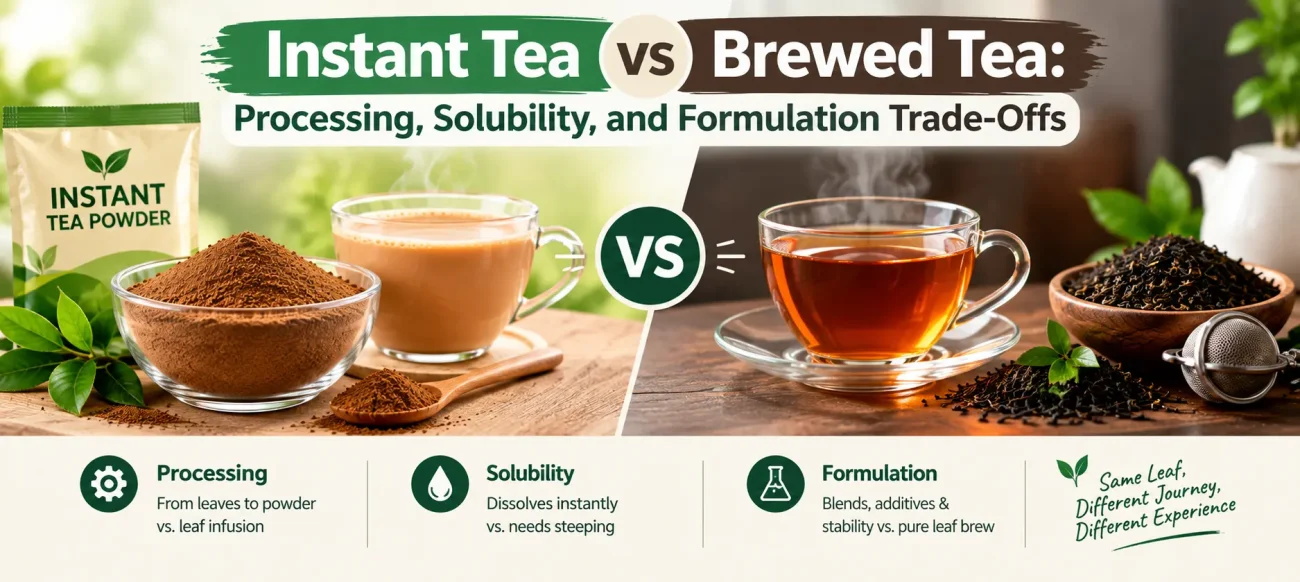
When evaluating instant tea vs brewed tea, the key differences lie in how the tea is processed, prepared, and used in finished products. Brewed tea is prepared by extracting soluble compounds from tea leaves in water, while instant tea undergoes further processing to create a dry, water-soluble ingredient. For food and beverage manufacturers, these formats can differ in solubility, storage, handling, formulation flexibility, and production efficiency. Understanding these factors helps businesses choose the right tea format for their application.
How Are Instant Tea and Brewed Tea Produced?
Both instant and brewed tea begin with extracting soluble compounds from processed tea leaves, but the subsequent processing stages determine their final form and applications.
Brewed Tea: Commercial Extraction and Concentration
Commercial brewed tea is produced by extracting tea leaves with water under controlled conditions. Temperature, extraction time, and the tea-to-water ratio influence the resulting liquid extract. The extract may then be filtered and concentrated for use in beverage manufacturing.
Because the ingredient remains liquid, manufacturers need to consider storage, transportation, handling, and shelf-life requirements when using brewed tea concentrate.
Instant Tea Powder: Extraction, Concentration, and Drying
Instant tea follows a similar extraction process, but manufacturers further process the concentrated tea extract by drying it. Depending on the product, manufacturers may use spray drying, agglomeration, or freeze drying to convert the liquid extract into a soluble powder.
This dry format can simplify storage, transportation, dosing, and incorporation into different formulations.
Read More: Tea Extract Benefits
Instant Tea vs Brewed Tea: Processing Comparison
The key processing differences between the two formats affect their final state, handling requirements, storage, and suitability for different production environments.
| Feature | Brewed Tea | Instant Tea Powder |
|---|---|---|
| Starting material | Tea leaves | Tea leaves |
| Main process | Extraction and concentration | Extraction, concentration, and drying |
| Final format | Liquid | Dry powder |
| Handling | Requires liquid handling | Easier dry-ingredient handling |
| Storage | More demanding | More convenient |
| Dosing | Liquid measurement | Powder-based dosing |
| Production scalability | More handling requirements | Suitable for large-scale formulation |
The appropriate format depends on the product’s processing setup, storage requirements, and desired final characteristics.
Solubility Profiles: Hot and Cold Water Performance
Solubility is an important specification when selecting an instant tea ingredient. The required format depends on how the finished beverage will be prepared.
| Format | Water Application | Key Consideration | Suitable Applications |
|---|---|---|---|
| Hot-water-soluble instant tea | Hot water | Rapid dissolution | Hot beverage premixes, vending |
| Cold-water-soluble instant tea | Cold or ambient water | Dissolution and clarity | RTD beverages, iced tea |
| Brewed tea concentrate | Liquid format | Requires liquid handling | Selected beverage applications |
Flavor, Color, and Sensory Profile
Processing can influence the flavor, color, aroma, and appearance of the final tea ingredient. Brewed tea provides a liquid extraction profile, while drying adds another processing stage that can affect the powder’s sensory characteristics.
For commercial formulations, consistency matters most. Variations in color, flavor, strength, and solubility can affect the finished beverage, making product specifications and batch-to-batch consistency important during procurement.
At Starlon Naturals, our instant tea extracts are available in hot-water and cold-water-soluble formats, helping manufacturers achieve the required flavor, color, and dissolution performance across different beverage applications.
Formulation Trade-Offs: When to Use Instant Tea Powder vs Brewed Tea
Base the choice on the application, production process, and performance requirements.
RTD Beverage Formulations
For RTD beverages, the choice depends on whether the product is ambient or chilled and on the required dissolution and sensory profile. Cold-water-soluble instant tea can be practical when dry-ingredient handling and consistent dissolution are priorities.
Hot Beverage Premixes and Vending
Hot-water-soluble instant tea suits premixes and vending applications because it can be blended with ingredients such as milk solids, sugar, and flavoring before preparation, making it a suitable option for businesses working with a coffee manufacturer.
Nutraceutical and Standardized Extract Applications
Where a formulation requires defined ingredient specifications, an instant tea extract can provide a controlled ingredient format. Procurement should focus on specifications and batch documentation appropriate to the intended application.
Cost, Scalability, and Supply Chain Considerations
Assess cost beyond the price per kilogram. Liquid brewed tea concentrate requires consideration for storage, transportation, handling, and shelf life. Instant tea powder can simplify dry storage, transportation, and dosing.
For manufacturers sourcing ingredients internationally, the dry format can also simplify inventory management and transportation, which can be beneficial when working with a Black Tea exporter. The final comparison should therefore consider total supply chain and production costs.
Related Read: Green Tea Extract Benefits
How to Choose the Right Tea Format for Your Application
When selecting between instant tea and brewed tea, consider:
- Application: Identify the final product and production environment.
- Solubility: Confirm whether the ingredient needs to dissolve in hot, cold, or ambient water.
- Processing setup: Consider whether your facility handles liquid concentrates or dry ingredients.
- Storage: Compare the handling and storage requirements of each format.
- Consistency: Review flavor, color, strength, and solubility specifications.
- Documentation: Check product specifications, certificates of analysis, certifications, and traceability.
At Starlon Naturals, we supply instant tea extract powders in formats designed for different beverage applications, including hot-water and cold-water soluble options.
| Application | Recommended Format | Key Reason |
|---|---|---|
| Ambient RTD beverage | Cold-water-soluble instant tea | Solubility and dry handling |
| Premium chilled beverage | Brewed tea concentrate | Liquid tea format |
| Hot beverage premix | Hot-water-soluble instant tea | Quick preparation and dry blending |
| Vending beverage | Hot-water-soluble instant tea | Convenient dosing and dissolution |
| Standardized extract application | Instant tea extract | Defined ingredient specifications |
| Private-label sachets | Instant tea powder | Easy portioning and packaging |
Conclusion
The choice between instant tea and brewed tea depends on the formulation, processing setup, and desired product characteristics. Brewed tea concentrate can suit liquid beverage applications, while instant tea powder offers greater convenience for dry handling, storage, dosing, and formulation. Factors such as solubility, sensory profile, consistency, and supply requirements should guide the selection. Looking for the right tea ingredient for your formulation? Connect with Starlon Naturals to discuss suitable instant tea formats.
FAQs
Does instant tea powder retain the same antioxidants as freshly brewed tea?
Processing can affect tea polyphenols and other compounds, so composition depends on the tea, extraction conditions, and drying method.
Which format is more cost-effective for large-scale RTD beverage production?
Instant tea powder can reduce liquid handling, storage, and transportation requirements, while brewed concentrate may suit specific production setups.
Can instant tea powder fully replace brewed tea?
The formats differ in processing, sensory characteristics, handling, and formulation requirements.
What is the shelf life difference between instant tea powder and brewed tea concentrate?
Shelf life varies by product and packaging. Instant tea powder is generally easier to store as a dry ingredient, while liquid concentrates require more controlled handling.
What technical documentation should a formulator request?
Depending on the application, request the product specification, certificate of analysis, ingredient information, relevant certifications, and traceability documentation.

